Selector Switches
A selector switch is a rotary, front-of-panel operator that allows users to choose between different machine or system modes by turning a knob, lever, or key. These devices are essential when multiple control options are required, such as switching between Auto/Manual, Forward/Stop/Reverse, or Hand-Off-Auto (HOA) settings.
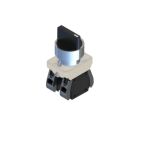
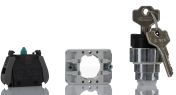
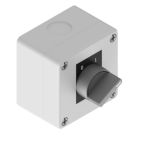
To simplify the procurement process, complete switch units are available, typically containing the actuator, contact block, and fixing collar. At RS, we offer a vast range of styles and colors, including the common 2-way selector switch and 3-way selector switch variants (also known as selector switch 2 position and selector switch 3 position). These are vital components in industrial control panels, HVAC systems, conveyors, and general automation.
What Is a Selector Switch?
A selector switch is a mechanical and electrical interface that changes the state of NO (Normally Open) and NC (Normally Closed) contacts to control electrical circuits. Unlike push buttons, selector switches may either remain in the selected position, or return automatically to a center or default position, depending on their design.
- Action Styles: Maintained (latching) types stay in one selected position until deliberately changed, while momentary (spring-return) types automatically return to a defined position after release.
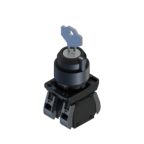
- Operator Types: Standard knob or lever-operated switches are used for general control, while key-operated versions restrict access to authorized personnel to help prevent unintended or unauthorized mode changes.
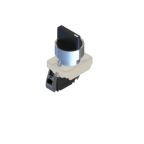
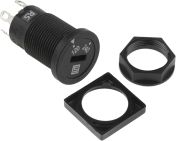
- Modular Ecosystem: Most industrial selector switches use a modular construction, allowing operators to be combined with stackable contact blocks. Common industry-standard panel cut-outs suit a wide range of control panels and enclosures, with sizes including 16 mm, 22 mm, and 30 mm.
How Do Selector Switches Work?
At the core of a selector switch is a precision cam mechanism. When the operator turns the knob or key, the internal cam rotates to physically depress or release snap-action contact blocks, effectively opening or closing specific electrical paths.
To ensure your switch functions correctly within your circuit, consider these three operational elements:
- Position Logic: The internal cam configuration defines the switching logic. A 2-position selector switch typically operates on an "Off-On" (0–1) pattern. In contrast, a 3-position selector switch may operate in a maintained or spring-return arrangement and is often used for applications such as "Hand-Off-Auto" or "Forward-Stop-Reverse," depending on the contact configuration selected.
- Indication and Illumination: Many units incorporate illuminated bezels to provide operators with immediate visual confirmation of the active state. If opting for an illuminated model, ensure the bulb or LED voltage is compatible with your control system, such as 24 VDC or 230 VAC.
- Electrical Ratings: The suitability of a switch depends on its contact block rating. Common categories like AC-15 (for electromagnetic loads) or DC-13 (for DC solenoids) determine if the switch can handle high-current direct coil control or if it should be limited to low-current PLC inputs. These ratings follow IEC 60947-5-1 standards for control circuit devices.
Types of Selector Switches
Categorizing switches by their technical specifications helps in selecting the right hardware for your panel:
- By Positions: Choose a 2-way selector switch for binary operations or a 3-way selector switch for multi-mode systems.
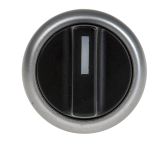
- By Operator: Knobs and levers provide high visibility, while key selector switches provide security for critical bypass or maintenance modes.
- By Contacts: Modular contact blocks allow for various configurations, such as 1NO/1NC, 2NO, or 2NC, depending on circuit requirements.
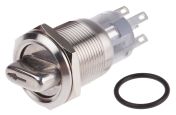
- By Construction: Plastic bezels are commonly used for standard industrial environments, while metal bezels are preferred where increased mechanical strength or higher ingress protection ratings (such as IP65, IP66, or IP67 at the front of panel) are required.
- By Mounting Size: Standardized panel cut-outs of 16 mm, 22 mm, and 30 mm ensure interchangeability and ease of replacement within existing control panels.
Features & Benefits of Selector Switches
Integrating selector switches into your control architecture provides several key advantages that enhance both system functionality and operator safety:
- Clear Mode Control: Defined detent positions provide tactile feedback, while optional legend plates or markings help operators clearly identify the active mode. This dual feedback system significantly reduces operator error in complex environments.
- Modular & Scalable Design: These switches are built for flexibility. You can easily add or swap contact blocks behind the panel to adapt functions as your system evolves, all without the need for additional panel drilling or structural changes.
- Rugged Durability: Designed for harsh conditions, high IP ratings (such as IP65 or IP67) ensure the front-of-panel interface survives constant exposure to dust, water, and industrial oils.
- Secure Access Control: For critical systems, keyed versions restrict mode changes to authorized personnel only, preventing unauthorized tampering with essential machinery parameters.
Where Can I Use a Selector Switch?
Selector switches are utilized across the industrial, infrastructure, and service sectors. Common applications include:
- Machine Control Panels: Used for mode selection such as Setup/Run/Teach, or as part of 3-position “Run–Stop–Reset” logic for programmable machinery.
- Motors & Drives: Perfect for selecting Forward/Reverse direction, Jog/Run functions, or switching between Local/Remote operations.
- Process & HVAC: Crucial for "Hand-Off-Auto" control of pumps, fans, and air handling units (AHUs), as well as multi-speed tap selection.
- Safety & Access: Key-operated versions serve as safety-related mode selectors for maintenance or bypass operations under specific permits.
How to Choose the Right Selector Switch
To ensure compatibility and performance when you buy selector switch units, here’s a guide:
- Positions & Action: Define if you need a 2-position or 3-position selector switch, and whether it should be maintained or spring-return.
- Contacts: Confirm the number and configuration (NO/NC) based on circuit requirements. It is often wise to allow for spare contact blocks for future expansion.
- Electrical Ratings: Ensure the contact blocks meet the required AC-15 or DC-13 utilization categories for the intended control circuit.
- Mounting Footprint: Match the 16 mm, 22 mm, or 30 mm size to your existing panel cut-outs.
- Environmental Conditions: Check for necessary IP ratings and material durability (metal vs. plastic) based on exposure to chemicals or vibration.
- Budget: Compare the selector switch price online in the Philippines to find the most cost-effective brand for your project.
- Installation & Wiring Tips
- To ensure the longevity and reliability of your control panel, follow these practical steps during the setup of your selector switch:
- Panel Preparation: Use a correct diameter punch or hole saw to match the 16 mm, 22 mm, or 30 mm specification. Always deburr the edges to ensure a flush fit and utilize the manufacturer’s anti-rotation tabs to prevent the switch from loosening over time.
- Contact Block Assembly: When assembling the unit, ensure the contact blocks are snapped firmly into the fixing collar. Verify that the mechanical interlocks engage correctly so that every rotation of the knob results in the intended electrical action.
- Professional Labeling: Use clear, high-visibility legend plates (e.g., HOA, FWD/STOP/REV). Carefully align the operator’s detents with these markings to prevent any ambiguity for the user.
- Pre-Energization Testing: Before applying power, perform a continuity check in every position. This verifies that the physical wiring matches your electrical diagram and ensures that the 3-position selector switch or 2-position logic is correctly implemented.
- Critical Safety Note: Standard selector contacts are typically not safety-rated devices. For emergency stops or critical safety interlocks, always route functions through appropriate safety-rated relays or controllers rather than relying solely on a standard selector switch.
Why Buy Selector Switches from RS Philippines?
As a trusted supplier of industrial automation and control gear, RS Philippines provides a comprehensive selection of selector switch solutions at competitive prices. Our products are sourced from reputable brands like Schneider Electric, RAFI, and Eaton, ensuring reliable and high-quality options for every application. Beyond switches, we offer a range of components, including interface modules and light curtain sensors, to ensure your entire control interface is professional and secure.
Browse our user-friendly site to find the best price on selector switches in the Philippines and have your components shipped directly to your door. With our swift and flexible delivery options in the Philippines, we ensure the timely arrival of your products. Visit ourdelivery information page for more details on delivery times and fees.
Popular Searches
Related links
- RS PRO RCAS Series 3 Position Selector Switch Head Black Handle, IP65
- Omron A22NZ 3 A, Push-in
- Idec YW Series 3 Position Selector Switch Head
- Schneider Electric Harmony 9001SK Series 3 Position Selector Switch Head IP66
- Schneider Electric ZB5FD5 Series 3 Position Selector Switch Head IP66, IP67
- Schneider Electric Selector Switch - (2 NO) 22 mm Cutout Diameter 3 Positions
- Idec Spring Return Selector Switch - (DPDT) 22 mm Cutout Diameter Illuminated 3 Positions
- ABB M2SS5 Series 3 Position Selector Switch Head, IP66