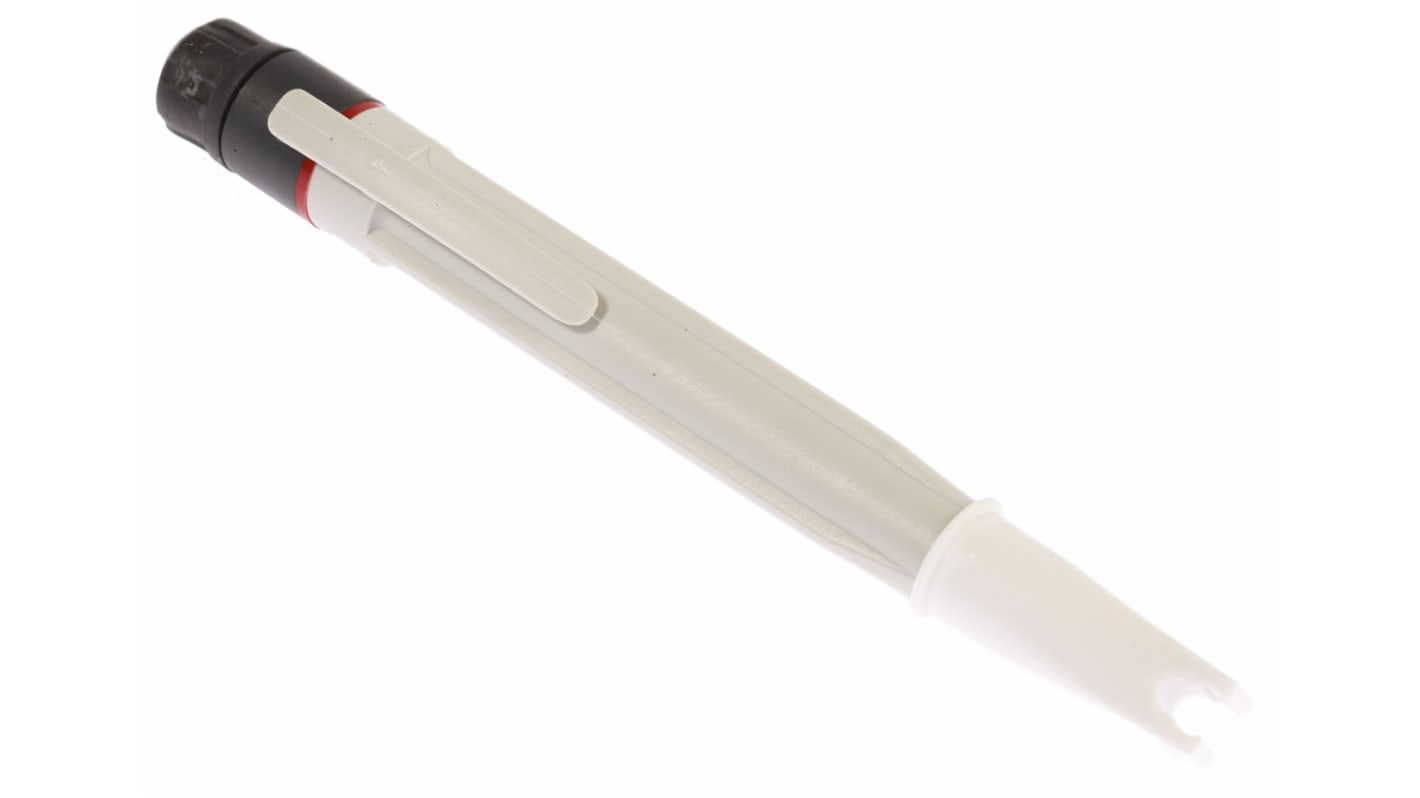
RS PRO Volt-Stick PRO Non Contact Voltage Detector, 230V ac to 1000V ac
- RS Stock No.:
- 166-838
- Manufacturer:
- RS PRO

Subtotal (1 unit)*
PHP3,746.56
(exc. VAT)
PHP4,196.15
(inc. VAT)
Stock information currently inaccessible
Units | Per Unit |
|---|---|
| 1 + | PHP3,746.56 |
*price indicative
- RS Stock No.:
- 166-838
- Manufacturer:
- RS PRO
Specifications
Technical data sheets
Legislation and Compliance
Product Details
Find similar products by selecting one or more attributes.
Select all | Attribute | Value |
|---|---|---|
| Brand | RS PRO | |
| Indicator Type | Voltage | |
| Battery Type | AAA | |
| Power Source | Battery | |
| Safety Category | CAT III 1000 V | |
| Weight | 40g | |
| Diameter | 18mm | |
| Length | 146mm | |
| Maximum Detection Voltage | 1000V ac | |
| Maximum Operating Temperature | +50°C | |
| Minimum Detection Voltage | 230V ac | |
| Safety Category Level | CAT III | |
| Model Number p | Volt-Stick PRO | |
| Safety Category Voltage | 1000V | |
| Minimum Operating Temperature | -10°C | |
| Select all | ||
|---|---|---|
Brand RS PRO | ||
Indicator Type Voltage | ||
Battery Type AAA | ||
Power Source Battery | ||
Safety Category CAT III 1000 V | ||
Weight 40g | ||
Diameter 18mm | ||
Length 146mm | ||
Maximum Detection Voltage 1000V ac | ||
Maximum Operating Temperature +50°C | ||
Minimum Detection Voltage 230V ac | ||
Safety Category Level CAT III | ||
Model Number p Volt-Stick PRO | ||
Safety Category Voltage 1000V | ||
Minimum Operating Temperature -10°C | ||
RoHS Status: Exempt
RS PRO Volt Stick PRO Non-Contact Voltage Indicator
The Volt Stick PRO is a pen style non-contact voltage detector from our high quality RS PRO brand. Able to safely check the presence of an AC voltage within cables, wall sockets and fuses junction boxes, conveniently no current flow is needed for operation. This is an essential tool for every electrician, technician or tradesperson.
Designed with a patented forked tip which has unsurpassed selectivity. This is because the maximum sensitivity is between the two prongs of the fork. The Volt Stick PRO also includes a tip adapter for larger cables and fuses, along with a clip in shunt for use as conventional low selectivity indicator.
Designed with a patented forked tip which has unsurpassed selectivity. This is because the maximum sensitivity is between the two prongs of the fork. The Volt Stick PRO also includes a tip adapter for larger cables and fuses, along with a clip in shunt for use as conventional low selectivity indicator.
Features and Benefits:
• Powerful red light tip which glows when voltage detected
• Fully insulated
• Altitude 2000 meters
• Non-Contact Detection of AC Voltage 230 V ac to 1000 V ac
• Battery: 2 x 1.5 V batteries (AAA) (included)
• Operating Temperature -10°C to 50°C)
• Rugged, double moulded case
• Safety Compliance: CAT III 1000 V
• Fully insulated
• Altitude 2000 meters
• Non-Contact Detection of AC Voltage 230 V ac to 1000 V ac
• Battery: 2 x 1.5 V batteries (AAA) (included)
• Operating Temperature -10°C to 50°C)
• Rugged, double moulded case
• Safety Compliance: CAT III 1000 V
Frequently asked questions:
What is a non-contact voltage tester used for?
Voltage testers or detectors are used to check the flow of current through a circuit. They can be used to check safety, or to ensure equipment is functioning correctly. They can also test for the current strength, whether the circuit is grounded correctly or to ensure no current is flowing at all so that work can be begin on the circuit.
How do non-contact voltage testers work?
Also known as a voltage detector, voltage tester pens, sensors or test pens. They allow the user to test electrical conductors without touching them. Non-contact testers are the safest and easiest way to detect electric fields or voltage. Voltage testers utilise what is called capacitive coupling, the user holding the instrument provides a ground reference. The tester then detects changing electric field around the object or objects conducting an AC current. (Alternating current) Simply put, the user and the tester pen when near the electrical conductor will cause a small current to flow through the tester from the source, this is how it detects AC voltage.
Voltage testers or detectors are used to check the flow of current through a circuit. They can be used to check safety, or to ensure equipment is functioning correctly. They can also test for the current strength, whether the circuit is grounded correctly or to ensure no current is flowing at all so that work can be begin on the circuit.
How do non-contact voltage testers work?
Also known as a voltage detector, voltage tester pens, sensors or test pens. They allow the user to test electrical conductors without touching them. Non-contact testers are the safest and easiest way to detect electric fields or voltage. Voltage testers utilise what is called capacitive coupling, the user holding the instrument provides a ground reference. The tester then detects changing electric field around the object or objects conducting an AC current. (Alternating current) Simply put, the user and the tester pen when near the electrical conductor will cause a small current to flow through the tester from the source, this is how it detects AC voltage.
Note
Will NOT detect cables behind buried plaster, buried trunking etc. and will not detect output from safety isolation transformers with earthed secondary centre tap. The unit should be checked for correct operation using a known voltage before use.
Supplied with
2 x AAA batteries and instructions.
Related links
- RS PRO Volt-Stick Non Contact Voltage Detector, 230V ac to 1000V ac
- RS PRO Volt-Stick SOUND Non Contact Voltage Detector, 230V ac to 1000V ac
- RS PRO IVP-1 Non Contact Voltage Detector, 100V ac to 1000V ac
- RS PRO AC-15EXs Non Contact Voltage Detector, 50V ac to 1000V ac
- CK T2271A Non Contact Voltage Detector 1000V ac
- RS PRO Non Contact Voltage Indicator, 230V ac to 1000V ac
- Klein Tools NCVT1P Non Contact Voltage Detector, 50V ac to 1000V ac
- Martindale VT7 Non Contact Voltage Detector 600V ac