Dial Indicators
Dial indicators are measuring devices widely used in mechanical and industrial applications. Also referred to as a dial gauge or dial indicator gauge, these instruments are designed to measure small linear displacements, whether in vertical or horizontal positions. They are also typically used to assess clearances, tolerance, and variation in tolerance of machined parts to ensure accuracy and quality.
Unlike micrometers or calipers that measure absolute dimensions, dial indicators excel at revealing deviations from a set reference point or baseline. A typical dial indicator features a plunger that contacts the workpiece, with readings displayed on an analog or digital face.
At RS Philippines, our extensive range of dial indicators includes analog or digital dials with imperial (in) and metric (mm) measurements, catering to diverse needs in the country.
Dial Indicator Functions
A dial indicator's primary function involves accurately gauging small linear displacements and deviations from a set reference point.
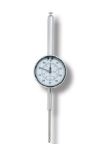
- Analog dial indicators use a mechanical pointer that moves across a graduated scale, providing an immediate visual reading of displacement.
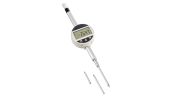
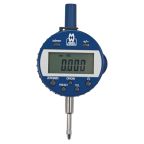
- Digital dial indicators show numeric values on an electronic screen, offering higher precision, better repeatability, and sometimes additional features such as preset alarms, data output, and unit conversion.
This distinction helps you select the right tool for tasks like precisely measuring the position of a shaft, determining the distance between two points, or assessing angles and depths.
Dial Indicator Gauge Types
Dial indicators come in various designs, each offering distinct mechanisms and features tailored for specific precision measurement tasks.
Plunger Dial Indicator
A plunger dial indicator measures linear displacement by translating the direct upward pressure from its contact point. This motion is multiplied through a sequence of gears and levers, producing an easily readable display on the dial face. These indicators are commonly used for checking runout, flatness, and parallelism.
Dial Test Indicator (Lever-Type Indicator)
Also known simply as a dial test indicator, this device uses a pivoting lever arm with a contact point that moves laterally rather than vertically. The lever's movement translates into rotational displacement on the dial, allowing the measurement of surface variations with high sensitivity. Dial test indicators are vital for fine alignment tasks, such as calibrating lathe chucks, verifying concentricity, and setting up machines for precise machining operations.
Who Uses a Dial Test Indicator
Dial indicators are used by mechanical engineers in applications such as;
- Mechanical Workshops: Dial indicators routinely verify shaft runout, confirm surface flatness, and check the parallelism of components. This oversight is crucial for maintaining high-quality mechanical assemblies.
- Precision Machine Shops: Vital for aligning workpieces accurately on machine tools such as lathes and milling machines. They meticulously confirm the precision of machined surfaces, ensuring strict adherence to exacting specifications.
- Lathe Workshops: A dial test indicator proves essential in lathe workshops for the precise setup of workpieces within chucks or fixtures. This helps secure concentricity and reduces vibration during machining operations.
- Discrete Manufacturing: Digital variants of the dial indicator are frequently integrated into automated quality control stations. They conduct automated checks on component dimensions and assembly accuracy, directly supporting efficient, high-quality production outcomes.
- Process Manufacturing: In process plants, a dial gauge monitors the alignment and stability of rotating equipment, including pumps and compressors. This enables early detection of excessive vibration, facilitating proactive maintenance strategies.
- Energy & Utilities: Dial indicators are employed for inspecting and maintaining turbines, generators, and other power generation equipment, helping ensure proper alignment and reliability.
- Facilities & Intralogistics: Within large facilities and intralogistics operations, professionals rely on dial indicators to verify the alignment of conveyor systems, assess platform levelness, and check the functionality of various mechanical components, promoting smooth and safe material handling.
Digital Dial Indicator VS Analog Dial Indicator
A digital dial indicator features an electronic display, providing clear numerical readings. These models typically offer higher resolution and greater accuracy, often including functions like data output, presets, and unit conversion. They excel in applications requiring precise measurements, data logging, or automation.
In contrast, an analog dial indicator uses a traditional needle and a physical dial face. While perhaps less precise than digital for very fine readings, many users find them intuitive for quickly gauging trends or checking relative movements.
How to Choose the Right Dial Indicator?
The suitability and ease of use of your dial gauge largely depend on its specifications. Consider these vital factors when making your choice:
- Precision and Display: Consider the smallest unit your measuring device needs to show. For tasks demanding stringent limits, a digital dial indicator typically provides clearer readouts and higher precision than an analog dial indicator.
- Measurement: Ensure the chosen dial gauge offers sufficient linear distance to capture the full displacement you anticipate measuring, which is vital for thorough assessments.
- Mounting Solution: Verify compatibility with your existing stands or fixtures. Common options include specific shank diameters, along with lug or plain backs, so ensure it integrates seamlessly into your setup.
- Readout Style and Units: Decide on your preferred scale presentation (whether a balanced dial for comparisons or a continuous full-range display) and measurement units, such as imperial or metric dial indicators. Lastly, clear markings are essential for accurate readings.
- Durability and Environment: Consider application environment; choose rugged, shock-resistant models with protective housings for harsh industrial sites.
Looking for a dial indicator for sale that encompasses all these considerations? Browse RS Philippines' range of precision tools and easily find the perfect fit.
Buy Dial Test Indicators and Dial Indicators Online from RS Philippines
As your dedicated partner in the dial indicator market in the Philippines, we simplify the process of finding the perfect dial indicator gauge for your exact requirements.
Our selection includes a wide array of options, such as durable analog dial indicators for straightforward readings, highly accurate digital dial indicators for detailed analysis, and specialized dial test indicators for specific alignment tasks. You'll find tools from our trusted RS PRO range, alongside Moore & Wright and Mitutoyo. Moreover, we also carry stock for other equipment to help with your projects, including thickness gauges and digital manometer pressure gauges.
We also provide flexible delivery across the country for your convenience. For more details on the delivery services and fees, please refer to our Delivery page.
Popular Searches
Related links
- DTI Gauges
- RS PRO Imperial/Metric Dial Indicator 0.01 mm Resolution , ±0.05 mm Accuracy
- Mitutoyo 575-123 Imperial/Metric Dial Indicator 0.0005 in Resolution , ±0.0008 in
- RS PRO Imperial/Metric Dial Indicator 0.005 mm Resolution , ±0.015 mm Accuracy
- RS PRO Imperial/Metric Dial Indicator 0.001 mm Resolution , ±0.005 mm Accuracy
- RS PRO Metric Dial Indicator, Magnetic Base Measuring Set
- RS PRO Plunger Dial Indicator Spindle Extension
- RS PROMetric Plunger Dial Indicator 0.01 mm Resolution