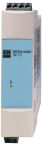
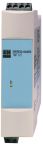
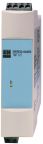
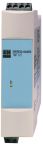
Temperature Transmitters
Temperature transmitters function as the interface between a control device and temperature sensor by converting signals from sensors such as thermocouples and RTDs/PT100 into robust process outputs, typically 4–20 mA, 0–10 V, or HART.
These electrical instruments support signal conditioning, linearization, electrical isolation, and strong noise immunity, making them essential for remote monitoring in industrial automation and process control. They ensure that temperature readings are accurately converted into standard instrumentation signals, enabling the process variable to be measured and controlled effectively.
What is a Temperature Transmitter?
A temperature transmitter is a device that converts raw sensor signals, such as those from RTDs like PT100 or thermocouples, into standardized analog or digital outputs understood by control systems, including 4–20 mA, 0–10 V, or digital protocols like HART. This conversion ensures the temperature data can be reliably interpreted by control systems.
In addition to signal conversion, the transmitter applies essential conditioning and linearization, using predefined curves such as PT100 IEC 60751 or thermocouple types K, J, and T.
It also performs cold-junction compensation and filtering to maintain accuracy. Furthermore, galvanic isolation is built in to prevent ground loops and enhance measurement stability, especially in electrically noisy industrial environments.
How Does a Thermocouple Temperature Transmitter Work?
When it comes to how thermocouple transmitters function, many people remain confused, and such knowledge gaps can affect your purchasing decisions. These devices are designed to convert thermocouple or RTD signals into standard output signals, typically 4–20 mA or digital signals such as HART.
A thermocouple works by using two dissimilar metals to generate a millivolt signal proportional to temperature, and the transmitter applies cold-junction compensation by measuring the terminal temperature to report the true process value. It then amplifies, filters, and linearizes this low-level input—including common thermocouple Types K, J, T, N, R, and S, before sending the conditioned signal to a controller such as a DCS or PLC.
Temperature transmitters also provide noise filtering, signal amplification, and galvanic isolation to ensure accuracy over long distances. As a result, costly wire extensions are avoided, noise resistance is improved, and the output signal becomes compatible with various control devices.
PT100 / RTD Temperature Transmitters
PT100 and RTD temperature transmitters are widely used where accuracy, stability, and repeatability are essential in process control. These devices convert the resistance-based signal from an RTD into a reliable process output that controllers can interpret with precision.
- RTD Principle: A PT100 changes resistance as temperature shifts. The transmitter provides excitation, measures the resistance, applies linearization, and outputs a stable 4–20 mA or digital signal.
- Wiring Methods: A 2-wire setup offers a basic connection, a 3-wire configuration compensates for lead-wire resistance, and a 4-wire arrangement delivers the highest accuracy.
- Accuracy & Stability: PT100/RTD temperature transmitters exhibit lower drift than thermocouples and are ideal for typical ranges from –50 to +200 °C, delivering excellent long-term repeatability in demanding applications.
Applications of PT100 Transmitters
PT100 transmitters are commonly used across industries that require precise, stable, and repeatable temperature measurement. Their accuracy and long-term reliability make them suitable for both critical process environments and general monitoring applications.
- Process Lines: Temperature transmitters are widely used in food and beverage, pharmaceutical, and chemical operations where tight temperature indication and control are essential for product quality and safety.
- HVAC & Utilities: They are applied in boilers, chillers, air-handling units, and district energy systems to ensure efficient heating, cooling, and system performance.
- Energy & Metals: Temperature transmitters are integral to power plants, heat exchangers, kilns, and annealing processes where stable temperature measurement directly affects efficiency and output quality.
- Water/Wastewater: They are used to monitor influent and effluent temperatures for regulatory compliance, process optimization, and reliable plant performance.
Types of Temperature Transmitters
Temperature transmitters are designed to accommodate various sensor inputs, installation preferences, and communication needs. Understanding transmitter types helps ensure you choose the right model for your application.
RTD (PT100 / PT1000) Temperature Transmitters
Specifically designed for platinum RTD sensors, a RTD transmitter, also known as PT100 transmitters, converts the resistance signals from PT100 or PT1000 elements into stable analog outputs such as 4–20 mA or voltage signals. They are widely used in industrial heating, HVAC systems, and general process control.
Thermocouple Temperature Transmitters
Built for thermocouple sensors such as Types K, J, T, E, N, R, and S, a thermocouple temperature transmitter amplifies millivolt input signals and produces linearized analog or digital outputs. They are ideal for high-temperature environments like furnaces, power plants, and manufacturing processes where fast, precise temperature monitoring is essential.
Universal or Linear-Resistance Temperature Transmitters
These versatile temperature transmitters accept multiple input types (RTD, thermocouple, resistance, and mV signals), providing flexibility for mixed sensor setups or future-proofing systems.
Programmable Temperature Transmitters
Featuring digital communication protocols like HART or Modbus, programmable temperature transmitters allow remote configuration of sensor types, output ranges, and diagnostic functions. These transmitters support advanced diagnostics, fault detection, and asset management to optimize uptime and maintenance.
Isolated Temperature Transmitters
Transmitters with galvanic isolation between input and output circuits mitigate ground loops and electrical noise, greatly improving signal integrity in electrically noisy industrial environments.
Common Form Factors Available
When you buy a temperature transmitter from suppliers, it will typically be available in a these forms:
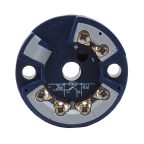
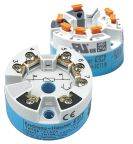
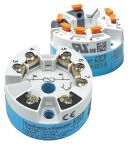
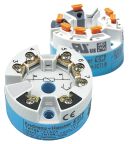
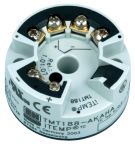
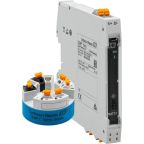
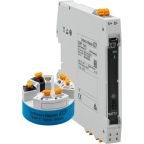
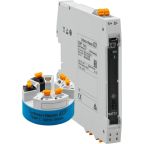
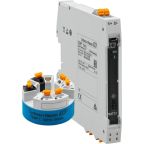
- Head-Mount Transmitters (DIN Form B): Compact units installed directly in sensor heads or thermowells, reducing lead length and improving measurement accuracy.
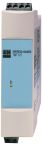
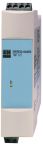
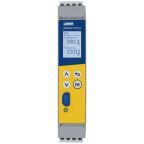
- DIN-Rail Transmitters: Designed for cabinet installations, enabling multi-channel setups with easy wiring, maintenance, and system integration.
Key Features & Benefits
A well-designed temperature transmitter, whether digital or analog, should offer the performance, stability, and protection needed for demanding process environments.
- Accuracy & Linearity: Support for Class A PT100 elements ensures precise, stable readings with minimal total error across the operating range.
- Isolated Outputs: Galvanic isolation protects against ground loops and electrical noise, preserving signal integrity in complex installations.
- Configurable Ranges: PC, mobile app, or HART tools allow quick setup of temperature transmitters, with lockable ranges to support QA and prevent unauthorized changes.
- Diagnostics: Built-in checks such as sensor break/short detection, upscale/downscale failsafe behavior, and status LEDs help streamline troubleshooting.
- Environmental Ratings: EMC-tested designs with IP67/IP68 ratings and wide ambient-temperature tolerance make these transmitters reliable in harsh conditions.
How to Choose the Right Temperature Transmitter?
Selecting the right temperature transmitters is easier when you match the device’s capabilities to your process, environment, and long-term maintenance needs.
- Sensor Input: Choose between PT100/RTD and thermocouple temperature transmitters, supporting 2-wire, 3-wire, or 4-wire RTD configurations.
- Output/Protocol: Consider 4–20 mA for most applications, 0–10 V for specific control systems, or HART for remote configuration and diagnostics.
- Accuracy & Stability: Review total error band, drift specifications, and cold-junction accuracy if you’re using thermocouple temperature transmitters.
- Isolation & Power: Confirm the isolation rating and decide between loop-powered or separately powered temperature transmitters.
- Mounting Style: Match head-mount, DIN-rail, or field-mount designs to your installation layout.
- Range & Ambient: Check measurement range, ambient limits, and IP ratings for environmental suitability.
- Compliance: Ensure any required IEC, ATEX/IECEx, or sanitary certifications are met.
- Budget & Availability: Compare features against the price of the temperature transmitter and choose reliable temperature transmitter suppliers when you buy.
Installation & Wiring Best Practices
Proper installation ensures your temperature transmitter performs reliably and delivers stable, accurate measurements across demanding applications.
- Lead Compensation: For a PT100 RTD temperature transmitter, use 3-wire or 4-wire configurations when higher accuracy is required, especially on long cable runs.
- Shielding & Grounding: Use twisted, shielded cables to reduce electrical noise, and ground the shield at one end only to prevent ground loops.
- Sensor Placement: Position the sensor at the proper immersion depth and ensure secure thermal contact to avoid measurement drift or lag.
- Loop Checks: Confirm loop polarity, verify the 4–20 mA current signal, and test upscale/downscale fault responses before commissioning your temperature transmitter.
Why Choose RS Philippines for Temperature Transmitters?
When buying temperature transmitters in the Philippines, RS, as a trusted supplier, offers a comprehensive range that supports reliable, accurate, and long-term temperature measurement.
With a wide selection in stock, from RTD transmitters and thermocouple temperature transmitters to advanced HART and digital temperature transmitters, you can quickly find the right fit for your process. Moreover, trusted brands such as Endress+Hauser, ifm electronic, and LKMelectronic ensure dependable performance backed by complete datasheets, certificates, and configuration resources.
We also offer a range of other useful equipment including, durometers, fiber testers, and more. Alongside this, we offer responsive local support and fast delivery in the Philippines. This makes it easier for you to compare different temperature transmitters by price and buy confidently. For more delivery information, visit our delivery page.