DIN Rails
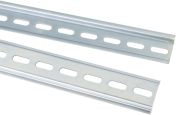
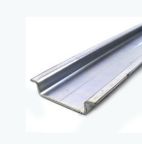
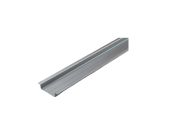
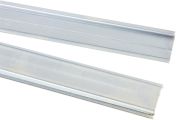
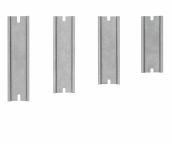
DIN rail (from Deutsches Institut für Normung, the German Institute for Standardization) refers to standardized metal mounting rails commonly used for installing electrical and industrial control components inside equipment racks, enclosure panels, and control cabinets. Originally standardized in Germany, DIN rails now follow various international standards such as European Norms (EN) and International Electrotechnical Commission (IEC) standards, enabling broad compatibility across manufacturers and equipment types.
DIN Rail Types
There are four common standard DIN rail types that vary in length and size:
Top Hat (EN 50022)
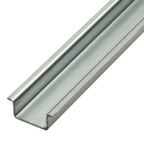
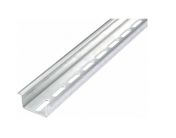
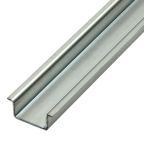
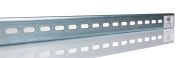
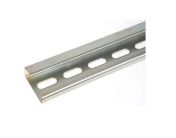
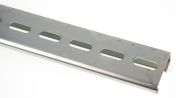
Known also as the TS35 rail, this is the most popular DIN rail type, featuring a 35 mm width and two depth variants: 7.5 mm and 15 mm. It comes in slotted and unslotted versions to accommodate different mounting needs. Top Hat rails are versatile and widely used for general industrial control equipment mounting, including terminal blocks, power supplies, relays, and PLC modules.
Miniature Top Hat (TS15) (EN 50045)
Also known as TS15 rail, this is a smaller variant of the standard Top Hat version, measuring 15 mm in width and 5.5 mm in depth. It's designed for compact devices and modular components where space is limited, such as in electronics enclosures or smaller industrial controllers.
C Section (TS32)
The TS32 or C-section rail has a cross-section shaped like the letter "C," providing greater structural strength. It is available in multiple sizes identified by their height dimensions; C20, C30, C40, and C50 (20 mm, 30 mm, 40 mm, and 50 mm heights respectively). These rails are ideal for mounting heavier or larger components requiring additional support.
G Section (G-Type) (EN 50035)
This DIN rail mounting features a distinctive curved and asymmetrical cross-section forming a "G" shape. The G-type DIN rail is purpose-built for heavy-duty applications needing maximum mechanical support. It’s commonly employed in environments with substantial vibration, shock, or heavy equipment loads.
How Does DIN Rail Work?
DIN rails function as standardized metal tracks, typically steel or aluminum, that are securely fastened to the rear wall or mounting plate of an electrical enclosure using screws. Their cross-sectional design allows compatible components, such as circuit breakers, terminal blocks, power supplies, relays, and PLC modules, to snap or slide into place, eliminating the need for individual panel mounting.
Most components feature molded clips or latch mechanisms that engage the rail’s shoulder or edges: you hook the top of the device onto the DIN rail and then press down until it snaps into position. If removal is needed, you lift or unlatch the bottom edge and the device unhooks easily. This enables an organized, efficient installation that supports component rearrangement and maintenance without needing tools or disassembly of the whole enclosure.
Stainless Steel DIN Rails
DIN Rails are typically made from materials like stainless steel, used when mounting electrical and industrial components in equipment racks, enclosure racks and panels, as well as control cabinets.
A typical mounting is made of perforated stainless steel or cold-rolled carbon-based steel with a zinc-plated or chromated bright surface finish to prevent galvanic corrosion. Stainless steel offers high corrosion resistance, making it ideal for harsh or outdoor environments, though it can be more expensive and harder to cut compared to standard steel.
Perforated and solid stainless steel DIN rails provide robust, durable mounting solutions ideally suited for exposure to moisture, chemicals, extreme temperatures, or corrosive atmospheres encountered in marine, food processing, and chemical plants.
The steel fitments are highly versatile and can be used across a wide range of applications, fitting various types of equipment, regardless of the manufacturer. DIN rails save time, space, and money by enabling users to mount electrical components safely and securely, especially when wiring is included.
Common Applications of DIN Rails
They are often used in applications such as:
- DIN Rail Terminal Blocks: Organize and secure wiring connections in control panels, allowing easy maintenance and reconfiguration.
- Automation and Control Devices: Mount PLCs, relays, timers, and contactors neatly for streamlined industrial process automation and easier troubleshooting.
- Power Supplies: Securely hold power supply modules alongside other components, reducing wiring clutter and ensuring reliable power delivery.
- Robotics Components: Support motor controllers, sensor interfaces, and communication modules in robotic systems for modular assembly and easy scaling.
- Plug-in Relays: Enable quick swapping or upgrading of relay components, facilitating remote or automated circuit control.
- Panel Meters: Mount meters monitoring voltage, current, and other parameters to provide clear visual system performance feedback in compact panels.
- Input/Output (I/O) Modules: Offer flexible connections between sensors, actuators, and controllers, allowing scalable automation setups.
- Programmable Logic Controllers (PLCs): Provide a secure, standardized mounting method for PLCs and related devices, helping create organized control panels.
- Contactors: Neatly integrate electrically-controlled switches used for motor or lighting control, simplifying wiring and troubleshooting.
Choosing the Right DIN Rails for Your Project
When selecting DIN rails, consider these key factors:
- Profile and Size Compatibility: Match the DIN rail type to your components' profile and size for optimal compatibility. TS35 is the most versatile, TS15 fits compact modules, TS32 supports heavier equipment, and G-Type is ideal for extra-heavy-duty setups.
- Material and Finish: Choose steel (zinc‑plated for standard use), stainless steel for corrosive environments, or anodized aluminum for lightweight corrosion resistance; copper DIN rails are used when grounding is required.
- Slotted vs. Unslotted: Slotted DIN rails allow screw penetration for direct device mounting; unslotted rails are simpler but may require clip-only attachment. Consider wiring ease and mounting preferences.Environmental Conditions: Ensure the DIN rail material and finish can withstand temperature extremes, humidity, dust, or chemicals specific to your installation site.
- Load Requirements: The mechanical load your components impose dictates the rail size and material strength. Use C-section or G-Type rails for heavier or vibration-prone setups.
- Standard Compliance: Use rails that meet DIN and European (EN/IEC) standards, such as EN 50022 (Top Hat) and EN 50035 (G-Type), to ensure cross-brand compatibility.
You can buy a wide range of DIN rails and accessories from RS in the Philippines. Simply search for “DIN Rail” on our website, filter by brand, length, width, height, and compatibility, and place your order.
Buy Stainless Steel DIN Rails Online from RS
As a trusted supplier and distributor of high-quality DIN rails in the Philippines, RS offers dependable solutions for a wide range of industrial and electrical applications. Our selection includes reliable products from our own RS PRO range, as well as globally recognized brands like Phoenix Contact, Schneider Electric, Siemens and more.
Whether you’re sourcing DIN rails or DIN rail terminal blocks, you can count on RS for consistent quality and competitive prices. Buy stainless steel DIN rails online and enjoy convenient delivery options, including next-day dispatch and standard shipping across the Philippines. For more details regarding delivery, please refer to our delivery page.